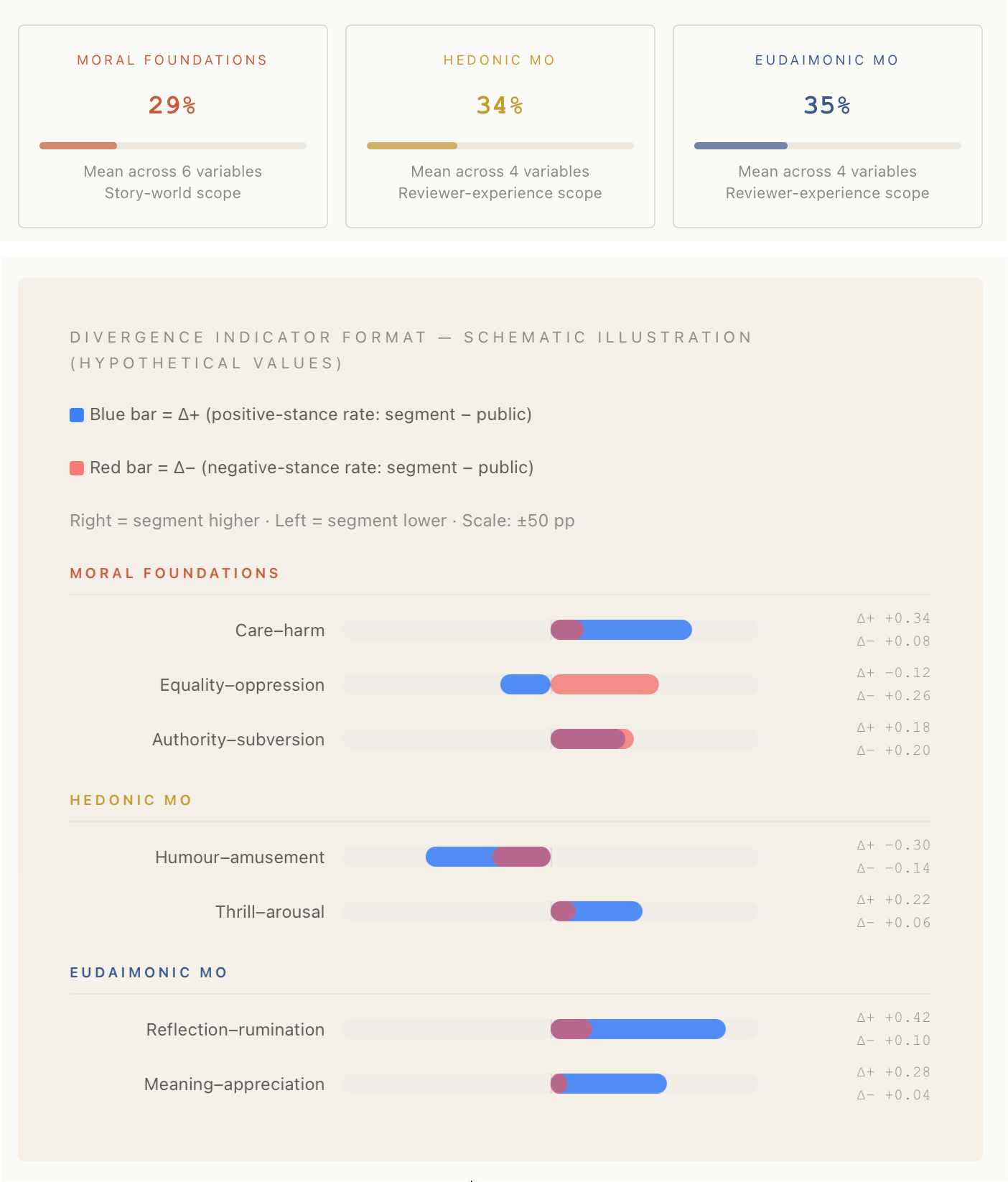
A team led by Prof. Manuel Pita (Artificial Intelligence, Social Interaction and Complexity Laboratory, CICANT) developed CineFlux, an audience analytics prototype that goes beyond box-office numbers and ambiguous sentiment analysis to reveal how audiences respond to films, with a focus on films from small European producers. CineFlux casts film reviews across sets of variables within the morality, hedonic, and eudaimonic dimensions, which are deeply relevant to audience studies but have hitherto been unexplored at scale.
Built within the EU-funded Crescine project (101094988 — CresCine — HORIZON-CL2-2022-HERITAGE-01), led by Universidade Lusófona, CineFlux uses AI-powered language analysis and theory-driven LLM annotation to extract audience reception patterns from thousands of film reviews and focus-group discussions.
Unlike commercial platforms that reduce audiences to clicks and ratings, CineFlux maps what viewers actually say: their moral reactions, their emotional pathways, and their points of friction, and makes those patterns visible, comparable, and traceable to evidence. A key novelty of CineFlux is that it allows us to quantify and explore how different audiences diverge in review patterns. The tool was piloted using Portuguese and Danish film data: 676 films, over 26,000 public reviews, and 10 dedicated focus group sessions with segmented audiences.
Every insight from CineFlux is auditable and self-explanatory, linking back to specific audience language, so funders and policymakers have transparent, theory-grounded evidence for their decisions.
CineFlux was presented at the NECS 2025 conference and is documented in a forthcoming Routledge volume on AI in the audiovisual industries.
The MVP demo is available at https://cineflux.ulusofona.pt/